Introduction
Protecting private conversations is a cornerstone of modern messaging apps. Meta has long relied on its HSM-based Backup Key Vault to offer end-to-end encrypted backups for WhatsApp and Messenger. This system generates a unique recovery code for each user, stored within tamper-resistant hardware security modules (HSMs) distributed across multiple data centers. The recovery code is inaccessible to Meta, cloud storage providers, or any external party, ensuring users retain sole control over their backup data.
Late last year, Meta simplified the encryption process by introducing passkeys. Now, the company continues to fortify the underlying infrastructure with two key updates: over-the-air fleet key distribution for Messenger and a commitment to publish evidence of secure fleet deployments. These changes enhance transparency and allow for more flexible, secure key management without requiring users to update their apps.
The Foundation: HSM-Based Backup Key Vault
The Backup Key Vault is deployed as a geographically distributed fleet across multiple data centers, using majority-consensus replication for resilience. When a user backs up their message history, a recovery code is generated and stored exclusively on the HSMs. Meta cannot access this code, nor can any third party, because the HSMs are designed to prevent unauthorized extraction of secrets. The system ensures that only the user, via their recovery code or passkey, can unlock their backup.
This architecture provides a strong foundation for privacy, but scaling it to new platforms—like Messenger—required additional innovation to maintain security without app updates.
Over-the-Air Fleet Key Distribution for Messenger
In WhatsApp, the public keys of the HSM fleet are hardcoded into the application. This works well for a fixed set of HSMs, but when Meta needed to deploy new fleets for Messenger without forcing an app update, a different approach was necessary. The solution is over-the-air fleet key distribution.
When a Messenger client establishes a session with the HSM fleet, it validates the fleet’s public keys using a validation bundle delivered as part of the HSM response. This bundle is signed by Cloudflare and counter-signed by Meta, providing independent cryptographic proof of authenticity. Cloudflare also maintains an immutable audit log of every validation bundle issued, enabling independent verification. The full protocol is detailed in Meta’s whitepaper, “Security of End-To-End Encrypted Backups.”
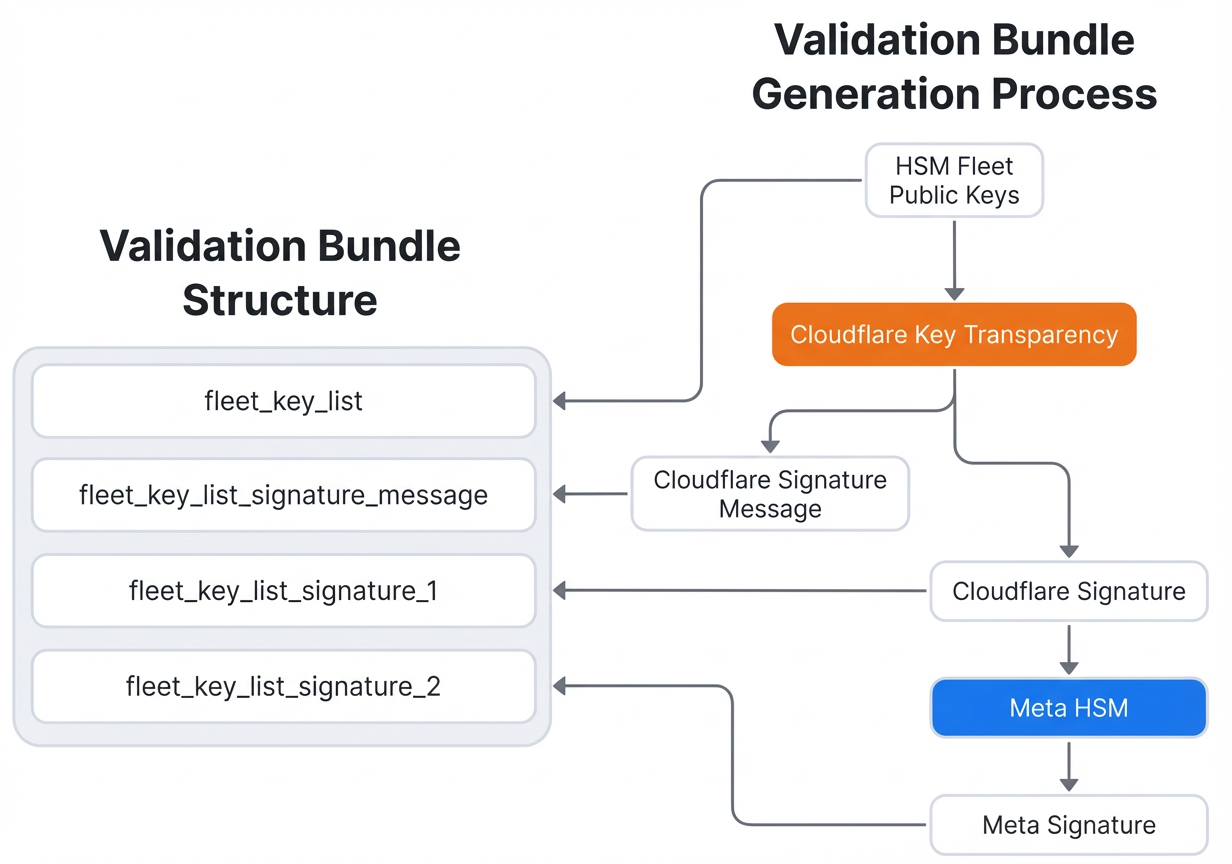
This mechanism ensures that even if a fleet is deployed dynamically, clients can trust the public keys they receive—preventing man‑in‑the‑middle attacks and maintaining the integrity of encrypted backups.
Commitment to Transparent Fleet Deployment
Transparency is critical to proving that the system operates as designed and that Meta cannot access user backups. To that end, Meta has committed to publishing evidence of the secure deployment of each new HSM fleet on this blog. New fleet deployments are infrequent—typically every few years—so each update is significant.
For example, when a new fleet is deployed, Meta will release cryptographic proofs and deployment details in a dedicated blog post. Users can then follow the verification steps outlined in the Audit section of the whitepaper to confirm that the new fleet was set up correctly and without malicious modifications. This practice cements Meta’s leadership in secure encrypted backups and builds trust among privacy‑conscious users.
Verification and Further Reading
For anyone wishing to audit the security of the Backup Key Vault, the complete technical specification is available in the whitepaper “Security of End-To-End Encrypted Backups.” The whitepaper outlines the cryptographic protocols, the HSM attestation process, and the exact steps to verify a fleet’s deployment. Meta encourages independent security researchers and users to review the documentation and confirm that their backups remain truly end‑to‑end encrypted.
With these updates—over‑the‑air key distribution and transparent fleet deployment—Meta continues to raise the bar for privacy in messaging, giving users greater control over their data without sacrificing convenience or security.